
6 Days Kilimanjaro Climb Marangu Route
A comfortable, hut-based six-day Kilimanjaro climb on the classic Marangu Route, with an extra acclimatization day at Horombo Hut before the summit.
- Duration
- 6 days
- Route
- Arusha – Marangu Gate – Mandara Hut – Horombo Hut – Kibo Hut – Uhuru Peak – Horombo Hut – Marangu Gate – Arusha/Moshi
- Start / end
- Starts at Kilimanjaro International Airport and ends in Moshi/Arusha
- Best time
- Kilimanjaro can be climbed year-round, but the drier months of January to mid-March and June to October usually offer the best conditions; hut accommodation adds comfort in wetter months.
- Trip style
- Private hut-based climb with professional guides, porters and a cook, sleeping in dormitory-style mountain huts with communal dining halls and all meals on the mountain.
Tour overview
The Marangu Route, also known as the Coca-Cola route, is the oldest and most established route on Kilimanjaro, and the only one offering dormitory-style sleeping huts instead of camping. Mandara and Kibo Huts each have 60 bunk beds and Horombo Hut has 120. Mattresses and pillows are supplied, but you still need a sleeping bag. The huts have communal dining halls and basic washrooms, ranging from flushing toilets and running water at the lower huts to long-drop toilets and buckets of water at Kibo Hut.
Serengeti Joy Tours offers Marangu as a five- or six-day private climb. This six-day version includes an acclimatization day at Horombo Hut on Day 3, which the five-day version does not.
Marangu is perhaps the easiest and most comfortable way to reach the summit of Kilimanjaro. The route is well developed and the climb is steady and moderate, with only the final summit approach being more demanding, and the simple mountain huts can be an advantage over the camping routes.
Highlights
- Hut accommodation on Kilimanjaro's oldest and best-established route
- Rainforest trail to Mandara Hut and a short walk to Maundi Crater
- Moorland views of Mawenzi and Kibo peaks
- Acclimatization day with a hike toward Mawenzi via Zebra Rocks
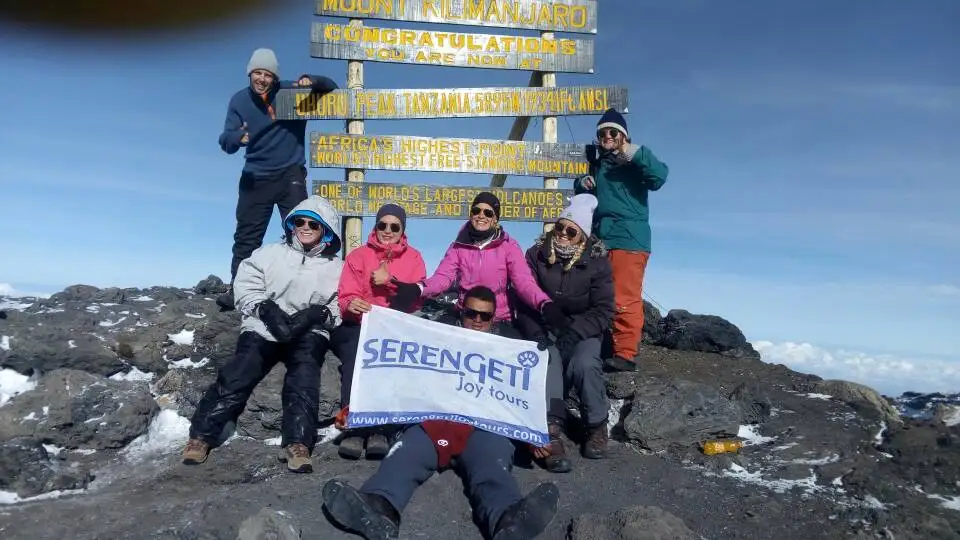
- Night summit attempt from Kibo Hut to Uhuru Peak (5,895m)
- Descent through the cloud forest and summit certificates at Marangu Gate
Day-by-day itinerary
ArrivalArrival at Kilimanjaro International Airport
You are welcomed by our mountain guide, who escorts you to a waiting vehicle and transfers you to the Mvuli Hotel in Arusha. Our tour coordinator will hold a short climbing briefing with you at the hotel, then leave you to relax and enjoy dinner. Use the evening to check your gear and rest before the climb.
Day 1Marangu Gate (1,800m/5,905ft) – Mandara Hut (2,743m/9,000ft)
Hiking time: 4-5 hours. Elevation change: +950m/+3,117ft. Distance: 7 km/4.35 miles. Habitat: montane forest. Depart Arusha/Moshi around 08:00 for Marangu Gate and climb registration. Begin your trek on a narrow trail through Kilimanjaro's rainforest, stopping for a picnic lunch at Kisambioni, the halfway point. Continue through the forest to Mandara Hut, then relax or take a short walk to Maundi Crater. On a clear day the views east over Taveta and northwest to Mawenzi Peak are striking, making the short hike well worth the effort.
Day 2Mandara Hut (2,743m/9,000ft) – Horombo Hut (3,720m/12,200ft)
Hiking time: 5-6 hours. Elevation change: +1,030m/+3,379ft. Distance: 11 km/6.84 miles. Habitat: moorland. After breakfast, leave Mandara Hut and the forest behind. Most of today's hike crosses Kilimanjaro's moorland, a rocky landscape with desert-like plants. Have a picnic lunch at Kambi ya Taabu before continuing to Horombo Hut, enjoying views of Mawenzi and Kibo peaks if the day is clear. You arrive at around 15:00 and spend the rest of the afternoon relaxing.
Day 3Acclimatization Day: Horombo Hut – toward Mawenzi Hut (4,600m/15,100ft) – Horombo Hut
Hiking time: 4-5 hours. Elevation change: +730m/+2,395ft. Distance: 7 km/4.35 miles. Habitat: moorland. This extra day and night at Horombo Hut is ideal for acclimatization. A hike toward Mawenzi, passing Zebra Rocks on the way (about three hours up and 1.5 hours down), is strongly recommended, as climbing higher and returning to sleep lower helps your body adjust before the push to Kibo Hut. Spend the rest of the afternoon resting at Horombo Hut.
Day 4Horombo Hut (3,720m/12,200ft) – Kibo Hut (4,750m/15,580ft)
Hiking time: 5-6 hours. Elevation change: +920m/+3,018ft. Distance: 7.46 miles. Habitat: alpine desert. After breakfast, continue your ascent into the alpine desert, passing the last water point at 4,130m (13,550ft). Fill your water bottles with all the water you will need until you return to Horombo Hut two nights later, unless you prefer to buy mineral water at Kibo Hut. The summit is a further 1,195m (3,921ft) up, and you make the final ascent the same night, so go to bed around 18:30 and get as much rest as possible.
Day 5Kibo Hut (4,750m/15,580ft) – Uhuru Peak (5,895m/19,340ft) – Horombo Hut (3,720m/12,200ft)
Habitat: alpine desert and arctic summit. Your guide wakes you around midnight for a hot drink and a light snack before the summit attempt. The trail climbs steadily over steep scree to Gillman's Point (5,685m/18,652ft) on the crater rim, then continues around the rim to Uhuru Peak (5,895m/19,340ft), the highest point in Africa. After summit photos, descend to Kibo Hut for a rest and a meal, then continue down to Horombo Hut for dinner and a well-earned night's sleep.
Day 6Horombo Hut (3,720m/12,200ft) – Marangu Gate (1,800m/5,905ft)
Hiking time: 5-7 hours. Elevation change: -1,878m/-6,161ft. Distance: 18 km/11.20 miles. Habitat: montane forest. After breakfast, end the trek with a beautiful descent through Kilimanjaro's cloud forest to Marangu Gate; watch your step, as the trail can be slippery. At the gate you sign out and successful climbers receive their summit certificates: silver for those who reached Gillman's Point (5,685m/18,652ft) and gold for those who reached Uhuru Peak (5,895m/19,341ft). Our vehicles will be waiting to take you back to Moshi/Arusha.
What is included
- All transfers to the mountain and back to your Arusha hotel
- Professional, experienced mountain guides
- Guide, porter and cook salaries
- Hut accommodation on the mountain with mattresses and pillows
- All meals on the mountain, with large portions of fresh, healthy, nutritious food
- Clean, purified drinking water
- Park fees, including conservation, hut and rescue fees
- VAT (18% charged by the government)
Not included
- Personal gear such as gloves, sunglasses, sleeping bag, hats, rain suit, warm jacket, heavy boots, scarves and rain trousers
- Extras at the lodges, such as drinks, telephone and laundry
- Visa and travel insurance
- Tips for the mountain crew (highly recommended)
- Surcharge for online payment of the deposit (5%)
Good to know
- Huts provide mattresses and pillows, but you need to bring or rent a sleeping bag.
- Suggested tips per day: porters USD 6-8, assistant guide or cook USD 12-15, guides USD 20-25.
- Fill your water bottles at the last water point (4,130m) on Day 4, or buy mineral water at Kibo Hut.
- A five-day version without the Horombo acclimatization day is also available.
Frequently asked questions
Where do we sleep on the Marangu Route?
Marangu is the only Kilimanjaro route with dormitory-style huts: Mandara, Horombo and Kibo Huts. Mattresses and pillows are provided, and the huts have communal dining halls and basic washrooms.
Why choose six days instead of five?
The six-day climb adds an acclimatization day at Horombo Hut, with a recommended hike toward Mawenzi via Zebra Rocks. Extra time at altitude helps your body adjust before the summit attempt.
What certificate will I receive?
At Marangu Gate, climbers who reached Gillman's Point receive a silver certificate and those who reached Uhuru Peak receive a gold certificate.
Similar tours
 9 daysLemosho in 8 DaysClimb Kilimanjaro on the quiet, scenic Lemosho Route over eight relaxed stages, with extra acclimatization time for a higher chance of reaching Uhuru Peak.From $2,049 ppView tour →
 5 days5 Days Kilimanjaro Climb Marangu RouteClimb Kilimanjaro in five days on the classic Marangu Route, sleeping in mountain huts and summiting Uhuru Peak on the most affordable option.From $1,306 ppView tour →6 days6 Days Kilimanjaro Trekking – Rongai RouteClimb Kilimanjaro from the quiet northern side on the least crowded Rongai Route, a six-day private trek with tented camps and descent via Marangu.From $1,497 ppView tour →